
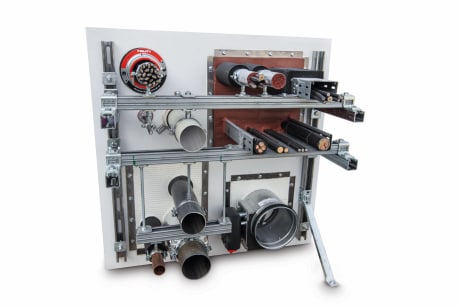
Passive Firestop Solution for Sandwich Panel Applications

The saying "time is money" holds significant importance in industries where productivity and profit margins are low. This is particularly true for the construction industry, where efficiency and speed can greatly impact financial outcomes. Within the construction sector, areas such as data centers and semiconductor facilities are especially sensitive to the speed of construction due to the high demand for their services and products.
In addition to the speed of construction, the selection of appropriate construction materials is critical. These materials should provide additional benefits, such as air tightness and durability, to ensure the success of the construction project. Over the past decade, sandwich panels have emerged as the preferred construction material for walls in many projects. This is especially true for hi-tech projects like data centers, semiconductor plants, and other industrial buildings, where the performance and reliability of the materials are paramount.
Sandwich panels consist of two outer layers, typically made of steel or aluminum, with a core material like mineral wool, polyurethane (PUR), or polyisocyanurate (PIR). The outer metal layers provide structural strength and durability, while the core acts as insulation, enhancing thermal and acoustic performance. However, ensuring effective passive fire protection in sandwich panel installations, especially in penetration applications, presents unique challenges.
FIRE PROTECTION CHALLENGES WITH PENETRATIONS IN SANDWICH PANELS
There are various types of sandwich panels available in the market, each exhibiting different behaviors under fire conditions. The way sandwich panels deflect, delaminate, and deform when exposed to fire is not consistent across all types. Consequently, it is challenging to predict standard behavior for sandwich panels under fire conditions. This variability necessitates specific testing of passive fire protection solutions for each type of sandwich panel to ensure their effectiveness.
Testing sandwich panel walls with and without joints and service penetrations is more complex than testing walls made of traditional materials because no industry-standard test covers sandwich panels. For example, in Europe, EN 1364-1 provides guidelines for testing non-load bearing walls but excludes sandwich panels. EN 1366-3 states that penetration seals in sandwich panels must be tested on a case-by-case basis, and approvals for flexible walls cannot be transferred to sandwich panels. 
HILTI'S PROVEN SOLUTIONS FOR SERVICE PENETRATIONS ON SANDWICH PANEL
Hilti invests heavily in testing their solutions to comply with the applicable codes and standards. Testing on sandwich panels is no different. Hilti has become a preferred partner for passive fire protection solutions to service penetration through sandwich panels on walls and ceilings thanks to extensive testing with different manufacturers. As an example, the Hilti CP 653 firestop speed sleeve is a standard solution for cable penetrations and Hilti CP 644 for mechanical penetrations in sandwich panel walls and ceilings for various manufacturers. In applications where there is no approval document, Hilti‘s expert engineers are well positioned to add value to the projects by producing bespoke engineering judgements.
At Hilti, we offer a special solution — a thoroughly tested system for structural beam penetration in sandwich panels, even considering deflections. This innovation is especially important for data center construction, where limited space makes access difficult. Our one-sided firestopping application, like Hilti CFS-BL blocks, provides an efficient and reliable solution. It ensures fire safety compliance without compromising structural integrity or ease of installation.
The use of prefabrication methods in the construction industry, like the use of sandwich panels, is gaining relevance because it helps reduce construction times, reduces logistics costs and simplifies the workflows on site. Prefabrication, however, requires planning from very early stages of the project. Therefore, additionally Hilti offers a variety of services and software like Firestop Selector, BIM and Fieldwire to support data center owners, specifiers and architects and contractors throughout the project lifecycle.

IMPACT ON SUSTAINABILITY AND THE ENVIRONMENT
sandwich panels offer sustainable benefits through their insulation properties, reducing energy consumption in heating and cooling. Hilti supports sustainable construction practices by offering Green Building Product Certificates that support projects with sustainability goals or aims for Green Building Certification (such as LEED 4.1 or BREEAM). The Product Carbon Footprint can be found in the Environmental Product Declaration and/or Life Cycle Assessments. Material Health Certificates provide a health assessment of the formulation. VOC test certificates confirm that emissions and content fulfil Green Building Standards. By combining fire safety with environmental responsibility, Hilti helps data centers achieve energy efficiency and long-term sustainability goals.
CONCLUSION
Hilti's firestop solutions are the backbone of fire safety and structural integrity in sandwich panels, especially in high-stakes projects like data centers and semiconductor facilities. With rigorous testing and proven effectiveness, these solutions pave the way for efficient and sustainable construction practices.
Learn more on passive firestop solutions in data centers:
Article : Protecting Digital Infrastructure - Passive Fire Protection in Data Centers
Webinar : Fire Protection & Modular Solutions for Data Centers
References:
· https://www.hilti.co.uk/content/hilti/E1/GB/en/business/business/engineering/fire-protection/firestop-in-sandwich-panels.html
· Building Better: the Benefits of Sandwich Panel Walls in Construction | Kunnuo Acoustic Panel
· https://blog.mannigroup.com/en/the-contribution-of-sandwich-panels-in-case-of-fire#:~:text=PIR%2C%20class%20B,fumes%20in%20case%20of%20fire.
